
Duplex Chain Sprocket
Duplex chain sprockets engage two chain strands to increase load capacity and stability in industrial transmission systems.
Explore product ↗ Request RFQ
Auxiliary drives, actuators, coal handling and maintenance systems need application-specific gearing with dependable service support.
Discuss an application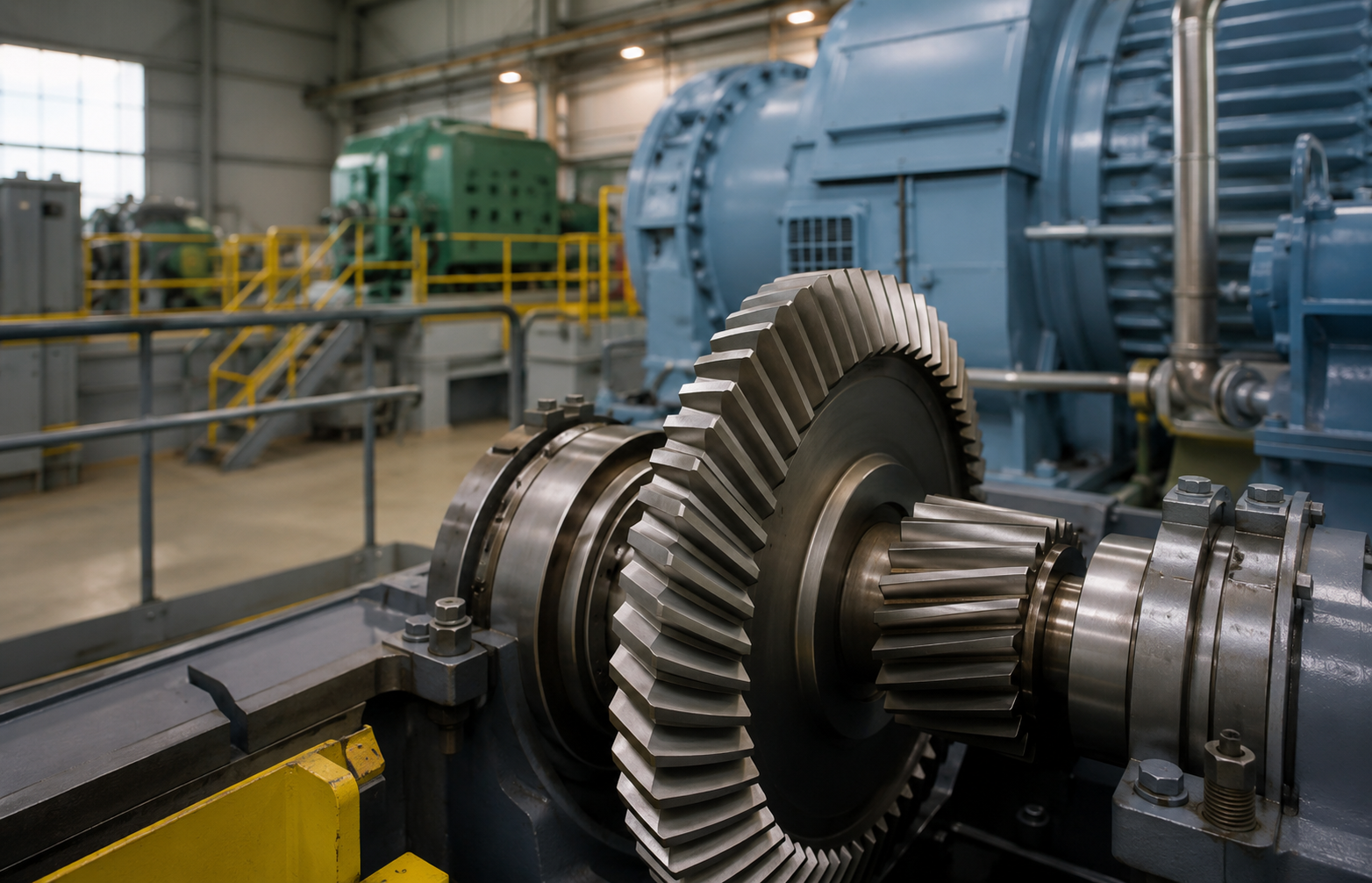
Component selection should consider torque, speed, shock, alignment, contamination, temperature, lubrication, inspection access and planned maintenance. A drawing alone may not reveal every service factor.
Revanta’s RFQ structure asks for the application context alongside geometry so replacement and OEM requirements can be reviewed more completely.
Duplex chain sprockets engage two chain strands to increase load capacity and stability in industrial transmission systems.
Explore product ↗
Bevel gears transmit rotary motion between intersecting shafts and are engineered around ratio, shaft angle, tooth geometry and load duty.
Explore product ↗
Helical gears use angled teeth for gradual engagement, higher contact ratio and smoother operation in parallel or crossed-shaft drives.
Explore product ↗
Rack and pinion systems convert rotary movement into controlled linear travel for positioning, steering and automation duties.
Explore product ↗
Feed screws convert rotary input into linear feed and are manufactured around lead accuracy, thread form, load, wear and nut compatibility.
Explore product ↗
Triplex chain sprockets engage three roller-chain strands for higher-load, shock-resistant industrial drive applications.
Explore product ↗This page intentionally avoids fabricated customer names, installations and performance figures.
Two gears with similar dimensions may require different materials, heat treatment and inspection because their operating duties are different.
Industrial drives must be reviewed against continuous and peak torque, speed, shock, reversing, cycle frequency, temperature, dust, moisture, corrosion, washdown, lubrication and maintenance access. High-cycle automation places emphasis on repeatability and backlash. Mining, cement and steel applications can place greater emphasis on shock, abrasion and practical replacement. Food, marine and utility equipment may add corrosion, hygiene or standby-service considerations.
Revanta Enterprises uses the industry description to organise relevant products, but the final component is manufactured from the approved drawing and order specification. Safety-critical, lifting, braking, regulated or classified equipment requires system-level approval by the responsible designer and applicable authority.
A strong RFQ includes the equipment name, drive position, motor power, ratio, input and output speed, load spectrum, duty cycle, existing material and heat treatment, observed failure mode and delivery location. Drawings should identify functional datums, fits, runout, backlash and measurement method. When a worn sample is submitted, mating dimensions and operating information help prevent the reproduction of an unknown failure cause.
The final quotation confirms manufacturing scope, commercial terms and any requested inspection documentation. No local factory, certification, stock position or delivery capability should be inferred from a market or industry page unless separately verified.